A Goan Diwali on a Plate: 6 Traditional Fov (Poha) Varieties You Must Try

There's something about Diwali mornings in Goa that feels different.
Perhaps it's the excitement of staying up late to watch the Narkasur celebrations, only to wake up a few hours later to the sounds of a busy kitchen. Or maybe it's the familiar smell of freshly grated coconut, jaggery melting slowly, and mustard seeds crackling in hot oil.
And then, of course, there's the food.

While Diwali celebrations across India are filled with sweets and festive delicacies, in many Goan homes, one humble ingredient takes centre stage: fov, the Konkani name for poha or flattened rice.
But we're not talking about just one bowl of poha. From sweet and creamy preparations to spicy, savoury and tangy variations, traditional Goan Diwali breakfasts can feature several different types of fov.
And here's the lovely part. Give the same ingredients to two Goan households, and chances are you'll end up tasting two slightly different versions.
So, if you've only ever had regular potato poha, you're in for a treat. Here are six traditional Goan poha varieties worth discovering this Diwali.
What Is Fov, and Why Is It Special During Diwali in Goa?
What Does “Fov” Mean in Konkani?
If you've grown up in Goa, you probably don't need an introduction to fov. But for anyone discovering Goan cuisine for the first time, fov is simply flattened or beaten rice, known as poha in many other parts of India.
It's an everyday ingredient that transforms beautifully depending on what you mix it with.
Add potatoes and spices, and you have a comforting savoury breakfast. Mix it with coconut and jaggery, and it becomes a sweet treat. Pour in some milk or buttermilk, and suddenly, you've got something entirely different.
That's the beauty of fov. It doesn't need anything fancy to become delicious.
Why Do Goan Families Prepare Different Types of Fov on Diwali?
Diwali in Goa has a special connection with Lord Krishna's victory over Narkasur.
According to a popular tradition, flattened rice was a favourite food of Lord Krishna, associated with the story of his childhood friend Sudama, who offered him a humble gift of poha. This connection is one of the explanations passed down for why fov holds such an important place in Goan Diwali celebrations.
Rice also has a long history in Goa's food culture, making fov a natural part of festive cooking.
On Diwali morning, after the traditional early baths, prayers and rituals, families gather around a breakfast spread that often includes several kinds of fov.
Some households prepare five varieties, while others make more or fewer. There isn't one fixed menu followed by everyone.
But the idea remains the same: good food, shared with people you love.
6 Traditional Goan Fov (Poha) Varieties to Try This Diwali
1. Batat Fov – The Savoury Potato Favourite

Let's begin with a familiar favourite.
Batat fov is one of those dishes that rarely needs convincing. It's simple, filling and packed with flavour.
Made with flattened rice, boiled potatoes, turmeric, green chillies and a tempering of mustard seeds, this savoury preparation is often finished with fresh coriander and grated coconut.
Some families add onions, while others prefer to keep them out, particularly when preparing food for religious occasions.
What makes batat fov so comforting is the balance of flavours. The potatoes give it a lovely softness, the chillies add a little kick, and the coconut brings everything together.
It's also the perfect dish to reach for when you've had one too many sweet treats.
2. Doodhantle Fov – A Little Sweetness in Every Spoonful

If batat fov is for those who love savoury food, doodhantle fov is for anyone with a sweet tooth.
Made by cooking or soaking flattened rice in milk, this preparation is sweetened with sugar and flavoured with cardamom.
The result is soft, creamy and wonderfully comforting.
Some families add cashews or raisins, while others keep it beautifully simple, allowing the milk and cardamom to do all the work.
It may remind you of a light rice pudding, but the texture of flattened rice gives it a character of its own.
And whether you enjoy it warm or slightly cooled, doodhantle fov is one of those dishes that tastes like it belongs on a festive breakfast table.
3. Rosantle Fov – The Magic of Coconut Milk and Jaggery

If there's one ingredient Goan kitchens know how to use well, it's coconut.
Rosantle fov is a lovely example.
Here, flattened rice is combined with coconut milk, locally called ros, and sweetened with jaggery. A touch of cardamom adds fragrance, while some families include sliced bananas for extra sweetness.
The coconut milk gives the dish a rich, silky texture without making it feel overly complicated.
It's the kind of preparation where the ingredients are ordinary, but the result feels special.
And like so many traditional Goan dishes, the flavour depends on the little details. The sweetness of the jaggery, the richness of the coconut milk and even the kind of fov used can make a difference.
It's definitely one to try if you want to experience the sweeter side of Goan Diwali food.
4. Godanche or Kalayile Fov – Simple Ingredients, Beautiful Flavours
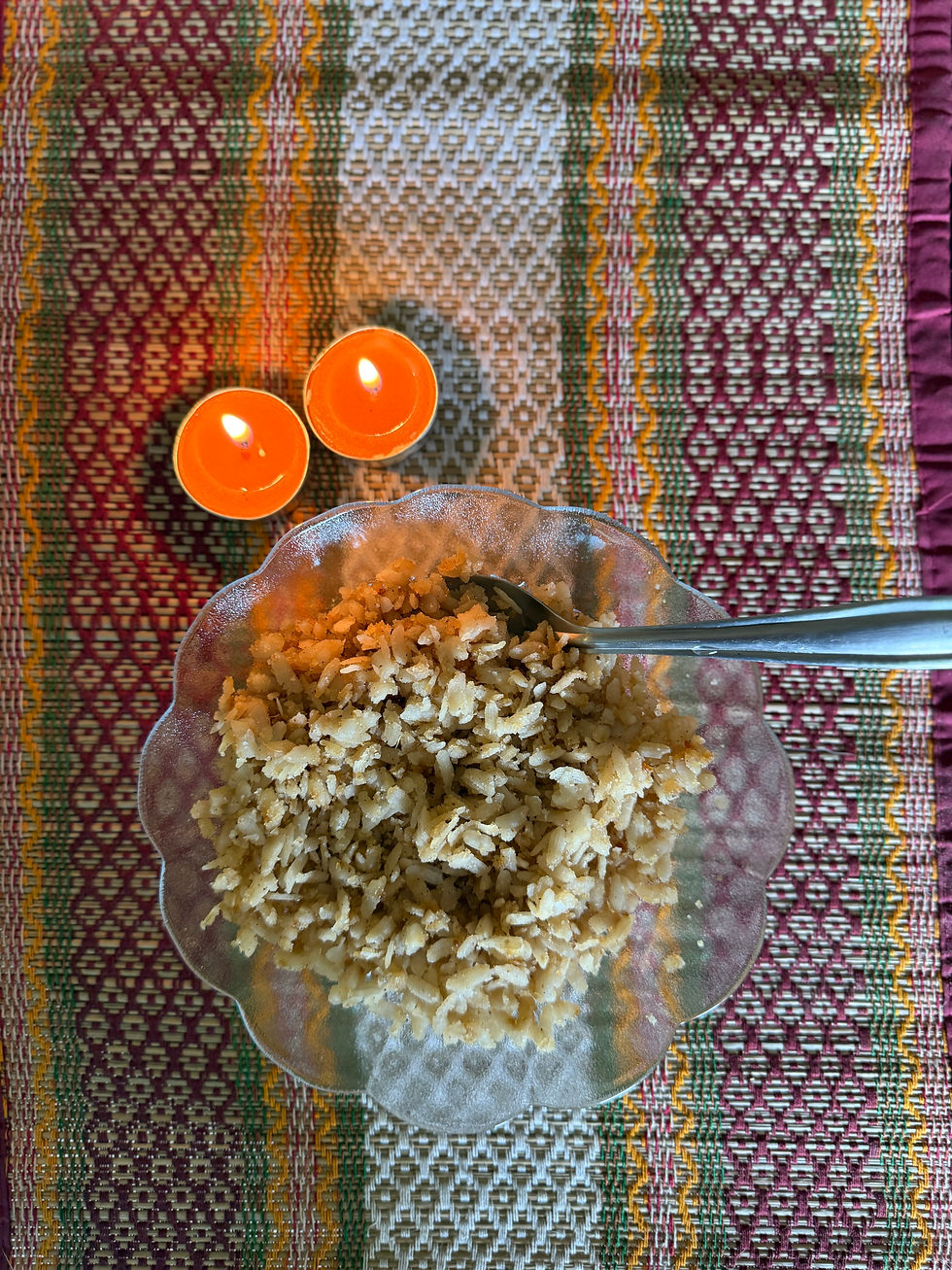
Sometimes, the simplest preparations are the ones people look forward to the most.
Godanche fov, also known in many homes as kalayile fov, is made by mixing softened flattened rice with grated coconut and jaggery.
That's really the heart of it.
Some families add cardamom, while others include banana or their own little variations.
Unlike rosantle fov, which has a coconut milk base, this preparation is generally less liquid and has a lovely texture from the freshly grated coconut.
Traditionally, the ingredients are often mixed by hand, allowing the jaggery and coconut to coat the fov evenly.
It's sweet without needing an elaborate recipe, and that's exactly what makes it special.
You might hear different names for similar preparations depending on the family or part of Goa you're visiting. After all, home cooking doesn't always follow a recipe book.
5. Dhaiyanche Fov – A Refreshing Change from the Sweets

After tasting a few sweet varieties, something light and tangy can be a welcome change.
Enter dhaiyanche fov.
This traditional preparation combines flattened rice with fresh curd. Depending on the household, it may be flavoured with salt, a little sugar, ginger, green chillies, coconut or a fragrant tempering.
The curd gives the fov a cooling, gently tangy taste, making it quite different from the milk-based and jaggery-based varieties.
It's not necessarily the first type of poha someone unfamiliar with Goan food would think of trying.
But that's what makes exploring regional food traditions interesting. Just when you think you know an ingredient, somebody prepares it in a way you haven't tasted before.
6. Taakantle Fov – Light, Tangy and Full of Flavour
Taakantle fov is another variety that proves poha doesn't always have to be sweet or potato-based.
This dish uses taak, or buttermilk, to give flattened rice a light, tangy flavour.
The buttermilk is commonly seasoned with ingredients such as mustard seeds, cumin, curry leaves, asafoetida and green chillies.
The result is refreshing, mildly spicy and quite different from the richer coconut and milk preparations.
It is especially enjoyable when you're sampling multiple types of fov because it brings a different flavour to the plate.
While taakantle fov and dhaiyanche fov may sound similar, the use of buttermilk instead of thicker curd creates a noticeably different consistency.
A small difference in ingredients, but a lovely difference in taste.
Sweet, Savoury or Tangy: Which Goan Fov Should You Try First?
Not sure where to begin? Here's a little guide to choosing your first bowl.
Fov variety | What to expect |
Batat fov | Savoury, mildly spicy and comforting |
Doodhantle fov | Sweet, soft and creamy |
Rosantle fov | Rich, coconut-flavoured and sweet |
Godanche / Kalayile fov | Sweet with jaggery and grated coconut |
Dhaiyanche fov | Cooling and gently tangy |
Taakantle fov | Light, tangy and mildly spiced |
Of course, the best way to enjoy fov is to taste more than one variety.
A little batat fov, a spoonful of rosantle fov and something tangy on the side make for a delicious combination.
And don't be surprised if you go back for seconds.
More Than Breakfast: How Goans Share Fov on Diwali
The Tradition of a Festive Fov Platter
In many Goan households, Diwali breakfast isn't limited to fov alone.
You'll often find other homemade preparations, such as chanyachi usal, moogachi usal, chutneys, ladoos, chakli and traditional faral, adding colour and variety to the table.
But what makes the morning memorable isn't simply the number of dishes.
It's the tradition of sharing them.
Neighbours visit, relatives drop by, and plates of festive food find their way from one house to another.
There's even a lovely Konkani invitation associated with the occasion: ‘Fov khavpak yo aamger,’ meaning, ‘Come home to eat fov.’
It's a simple phrase, but it captures something special about the festival.
Because in Goa, food has always been one of the nicest ways to bring people together.
Why Every Goan Family Has Its Own Version
Ask two Goan families how they make their favourite fov, and you might receive two different answers.
One home might prefer its rosantle fov sweeter, while another adds more coconut milk. Someone might insist that godanche fov tastes best with freshly grated coconut, while another family has its own little twist.
Even the number of varieties prepared on Diwali morning changes from household to household.
These differences aren't something to correct. They're part of what makes traditional cooking so interesting.
Recipes are often passed down through generations, with measurements remembered by the hand rather than written on paper.
A little more jaggery. Just enough milk. A handful of coconut.
And somehow, the taste is exactly what the family remembers.
How to Enjoy Goan Fov at Home This Diwali
Start with a Mix of Sweet and Savoury Fov
If you're planning to try traditional Goan poha varieties at home, you don't need to prepare all six at once.
Start with a small selection.
Batat fov is a great savoury option, while rosantle or godanche fov adds something sweet. You could also prepare taakantle or dhaiyanche fov for a lighter, tangier contrast.
Simple Preparation Tips for First-Time Cooks
One thing worth remembering is that not all flattened rice is the same.
Thicker varieties may need a little more soaking or rinsing, while thinner fov can become mushy if left in water too long.
Fresh coconut can make a noticeable difference in traditional preparations, and the amount of jaggery or spice can always be adjusted to suit your taste.
Most importantly, don't feel that every recipe must turn out exactly like somebody else's.
Traditional Goan cooking has always left room for family preferences.
Frequently Asked Questions About Goan Diwali Fov
What is fov in Goan cuisine?
Fov is the Konkani name for poha, or flattened rice. It's used in both sweet and savoury dishes and is especially important during Diwali celebrations in many Goan households.
How many types of fov are made during Diwali in Goa?
Many Goan families traditionally prepare around five varieties of fov during Diwali, although some prepare more or fewer. The selection depends on family customs, preferences and recipes passed down through generations.
Why do Goans eat fov during Diwali?
Fov is associated with the tradition of Lord Krishna and Sudama and has become an important part of Goan Diwali celebrations. The dish also reflects Goa's rice-based food culture and the custom of sharing festive meals with family and neighbours.
Which Goan fov varieties are sweet and which are savoury?
Doodhantle, rosantle and godanche fov are generally sweet preparations. Batat fov is savoury, while dhaiyanche and taakantle fov offer tangy or mildly spiced flavours, depending on the recipe.
Is Goan fov the same as regular poha?
The main ingredient is the same: flattened rice. However, Goan fov preparations include several traditional sweet, savoury and tangy variations made with ingredients such as coconut milk, jaggery, curd and buttermilk.
One Ingredient, So Many Goan Diwali Memories
There's a reason some foods become inseparable from festivals.
They remind us of familiar kitchens, family gatherings, favourite dishes and little traditions that return year after year.
For many Goan families, fov is one of those foods.
It's not about preparing the most elaborate breakfast or making the largest number of varieties. It's about bringing people together over food that carries a little bit of home in every serving.
And while every family might have its own favourite way of preparing it, that's perhaps the nicest thing about Goan Diwali traditions. They don't all have to look or taste exactly the same to be cherished.
So, this Diwali, here's a question for you: Which type of fov is an absolute must-have at your home?
And if you're curious to discover more of Goa beyond its beaches, explore the local food, traditions and cultural stories that make this little state so special with Soul Travelling.