
North Goa During Monsoons: A Local's Guide to Monsoon 2026
- Diya Padiyar
- Jul 2
- 6 min read

There is a version of North Goa that only exists for four months of the year, and almost nobody plans a trip around it on purpose.
It starts sometime in June, when the sky changes colour first and the sea follows a few days later. By July, the hills behind Assagao and Siolim have gone from brown to a green so deep it looks unreal in photos. The beach shacks that define North Goa the rest of the year are shuttered and stacked. And somewhere in that quiet, a different Goa shows up, one built around forts in the mist, cafes that smell like wet earth and cardamom, forests that glow after dark, and villages that seem to fold in on themselves and get smaller, warmer, more like actual homes than backdrops.
Most people who visit Goa only ever see the version built for December, hot, crowded, loud. This is a guide to the other one. Not a checklist, a way of moving through North Goa during monsoon 2026 the way people who actually live here do, slowly, without a fixed plan, led more by weather than by itinerary.
The Forts Belong to the Weather Now
Aguada and Chapora are postcard famous in December, all golden light and Instagram queues. In the rains, they empty out almost completely, and the weather takes over the job the crowds usually did, giving the place its drama.
Go to Chapora in the late afternoon, when the clouds are moving fast over the Chapora river below and the fort's laterite walls have gone a deep rust red from the rain. Go to Aguada when the sea is loud enough that you cannot hear your own footsteps on the old stone, and the lighthouse disappears into low cloud for minutes at a time. Reis Magos, smaller and less visited even in peak season, is worth it for the quiet alone, a fort, a restored chapel, and almost no one else, just you and whoever is manning the small museum inside.
None of this requires planning. It requires showing up and being willing to get a little wet.

Somewhere Between a Cafe and a Greenhouse
Assagao in monsoon does something odd to its own cafes, gardens grow louder, kitchens lean into comfort food, and the pace of service slows to match the rain outside. This is not a coincidence. This is the whole point of the season here.
Spend a morning in Assagao without an agenda. A long breakfast somewhere with a garden view, a slow coffee somewhere else an hour later, no itinerary beyond staying dry and unhurried. Anjuna's clifftop cafes do the same thing with a sea view instead of a garden, storm clouds building over the water while you eat, the Arabian Sea looking genuinely dangerous rather than postcard blue.
This is also, quietly, the best time of year to actually get a table. The queues that define these same cafes in December simply do not exist in July.
Fontainhas, Slower Than Usual
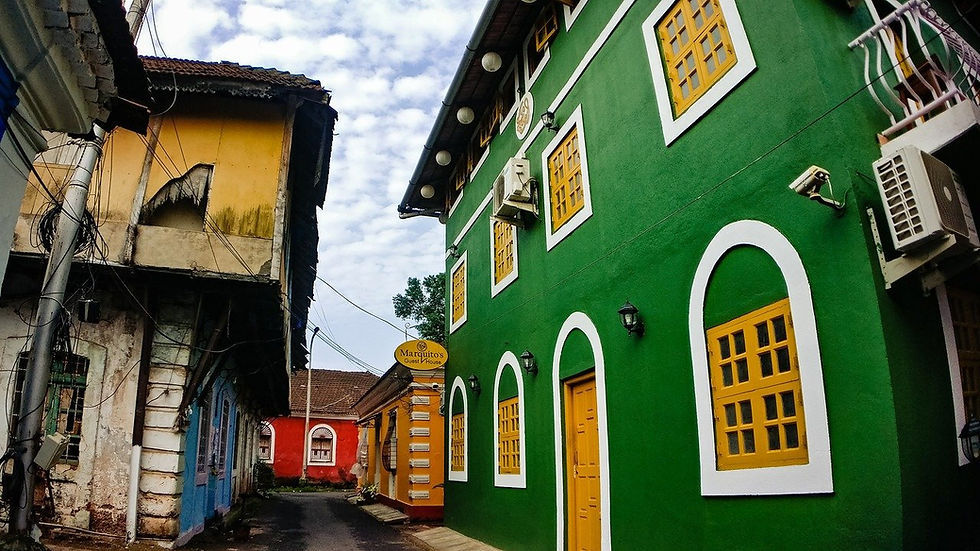
Panjim's old Latin Quarter does not need monsoon to be beautiful, but the rain adds something to it anyway, wet stone, brighter paint against grey skies, streets with almost no one else in them. This is when Fontainhas stops being a place you photograph quickly and becomes a place you actually walk through, balcony by balcony, doorway by doorway.
A guided version exists for a reason, the stories behind these houses and streets are not obvious from the outside. Who built which house, why a particular chapel sits where it does, what the neighbourhood looked like before restoration turned parts of it fashionable again, a local walk through Fontainhas turns a nice looking neighbourhood into something with real history attached, the kind you cannot get from a guidebook.
The Quieter Villages Slow Down Too
Beyond the well known names, North Goa's smaller villages, Siolim, Saligao, Moira, Aldona, take on a version of monsoon that rarely makes it into travel guides at all. Paddy fields around Aldona flood and turn a bright, almost artificial green. Saligao's old church and surrounding lanes empty out completely on a rainy weekday afternoon. Moira, known for its bananas and its old families, feels less like a destination and more like somewhere you have accidentally wandered into someone's actual life.
None of these need a plan either. A scooter, a rough direction, and a willingness to stop wherever looks interesting is the entire method.
Getting Around Without Losing the Whole Day to Rain
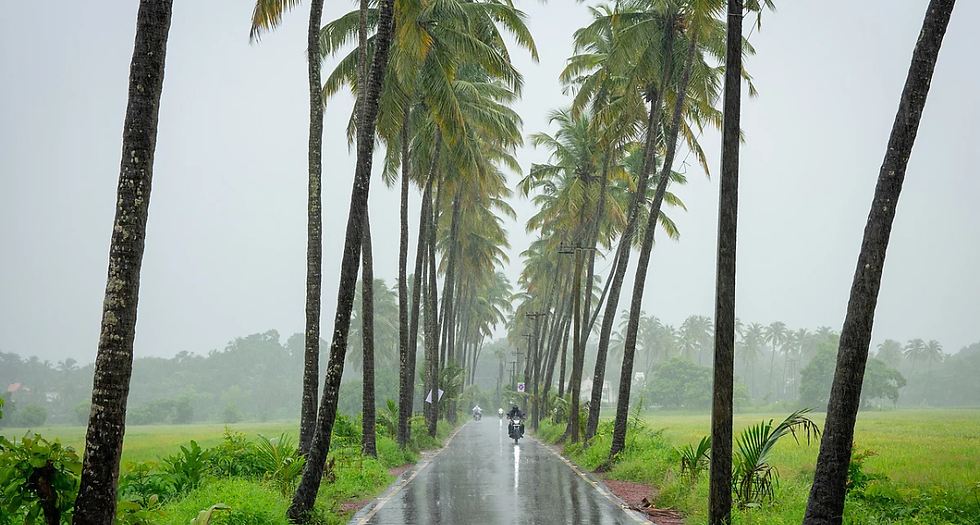
Roads flood, sometimes briefly, sometimes for a few hours after a heavy spell. A scooter with good tires and genuine caution beats a car for most of North Goa's inner lanes, since a scooter can navigate around a flooded stretch that would strand a car. That said, a raincoat that actually works matters more than the vehicle, ponchos flap and tear on a moving scooter, a proper two piece rain suit holds up far better across a full day out.
Locals check the sky, not the forecast app, before deciding whether to head out. Clouds building fast and dark from the east usually mean an hour of heavy rain, not a full day lost. Patience, more than planning, is the actual skill here.
The Food Gets Heavier, on Purpose
Ask anyone who grew up in Goa what monsoon tastes like and the answer usually involves a thick coconut based curry, rice, and something fried on the side. This is comfort food season, built for grey skies and a table you are not in a hurry to leave.
Look for patoleo if you can find it, a monsoon specific rice cake steamed in turmeric leaves with jaggery and coconut inside, made in home kitchens more often than restaurants, which makes finding it part of the fun. Fish thalis get better this time of year too, the catch smaller but fresher, closer to shore.
The Rivers Take Over From the Beaches
With the sea too rough to swim in, North Goa's rivers and islands become the better option for slow travel.
A ferry ride out to Divar Island in the rain is closer to time travel than tourism, old homes, quiet lanes, and if timing lines up, the Bonderam flag festival in August, one of the most colourful, least touristy events on the Goa calendar.

What Is Genuinely Not Worth It This Season
Water sports are largely shut, and the ones technically running are not worth the risk given sea conditions. Beach shacks are closed or operating at a fraction of their usual self, so do not build a trip around beach dining. Sunset points lose their entire appeal without a visible sunset, most evenings the sky is simply grey until it is dark. None of this should discourage a monsoon trip, it should just reset expectations toward what the season is actually good for, forests, forts, food, and quiet, rather than what it is not.
What Monsoon in North Goa Actually Asks of You
Not much, honestly. A raincoat that works. Shoes you do not mind getting wet. A willingness to let plans shift with the weather instead of fighting it. And the patience to sit somewhere for two hours doing very little, which is, if you let it be, the entire appeal of the season.
Frequently Asked Questions
Is North Goa worth visiting during monsoon?
Yes, particularly for travellers who have already done Goa in peak season and want to see it without the crowds. Forts, cafes, rivers and forests all take on a different character, and prices tend to be noticeably lower.
What is the best time in monsoon to visit North Goa?
Late June through early September, with July and August being the most intense in terms of rainfall, and early September often offering the best balance of lush scenery and easing rain.
Can you swim at North Goa beaches during monsoon?
No, the sea is too rough and swimming is generally restricted for safety. Beaches are still worth visiting for the atmosphere, just not for swimming.
How many days do you need for a North Goa monsoon trip?
Three to four days covers the core of it comfortably, a day for forts and cafes, an evening for the bioluminescence forest, a day for Fontainhas and the quieter villages, and a day held loosely for whatever the weather allows.
Is it cheaper to visit North Goa during monsoon?
Generally yes. Stays and many experiences see lower demand outside peak season, though it is worth booking guided experiences in advance regardless, since weather dependent slots can shift or fill despite the quieter season overall.
Is North Goa monsoon travel good for families?
Yes, particularly the guided experiences, heritage walks, forest experiences and river island trips are all manageable for most fitness levels and tend to be less physically demanding than the South Goa waterfall treks.
North Goa in the rains is not a compromise on the version of Goa most people expect. It is a different trip entirely, quieter, greener, and considerably more interesting if you let it be.





Thanks for sharing this lovely guide! It sounds like monsoon season in North Goa offers some unique experiences. I've been enjoying Poople lately - it's a fun way to challenge my brain each day.
The explanation of upsarg is very useful for understanding Hindi grammar concepts clearly. It helps learners identify different types of prefixes and their role in word formation.
Karak ke Bhed in Hindi grammar helps us understand the relationship between the noun and verb in a sentence, making the sentence structure clear and meaningful in communication.
Understanding vachan in Hindi becomes much easier when examples are included. It helps learners identify singular and plural forms correctly and improves both grammar knowledge and sentence construction skills.
Understanding Kriya is important for learning Hindi grammar because it explains actions in a sentence and helps students improve their sentence formation and language skills effectively.