
Goa Carnival 2026: Why This Local Festival Is Worth Witnessing

Updated: Feb 10
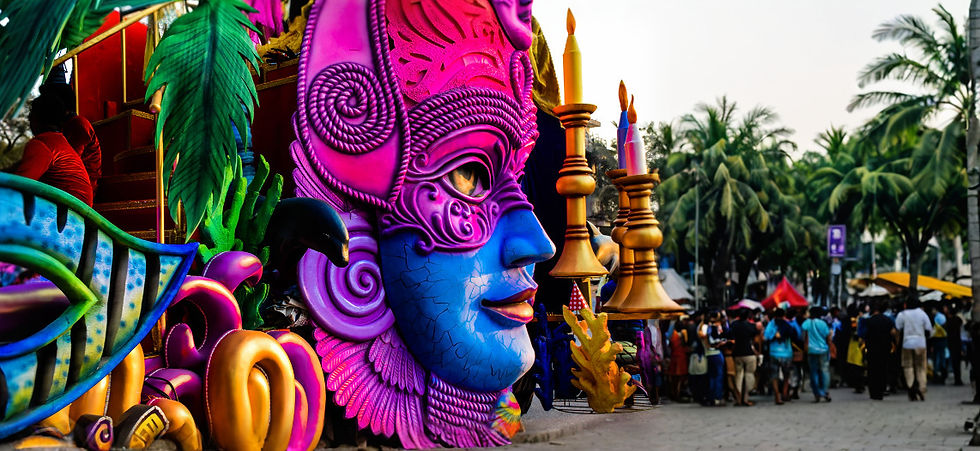
If you’re born in Goa, Carnival isn’t something you mark on a calendar.
It’s something you feel approaching.
You sense it before the first float appears, in louder conversations, children arguing joyfully over costumes, and elders revisiting memories of Carnivals long past. For us, Carnival isn’t an event. It’s memory. It’s rhythm. It’s instinct.
That’s exactly why Goa Carnival 2026 is worth witnessing, not as a spectacle, but as a living, breathing part of Goan life.
Carnival in Goa Is Not a Performance for Tourists
Unlike many large festivals that slowly turn into spectacles, the Goa Carnival is still deeply personal.
For four days before Lent, the state slips into a different rhythm. Streets become louder, humour becomes sharper, and everyday roles soften. Shopkeepers joke more freely. Children dress up with serious intent. Elders sit along the roads, watching not just the floats, but people.
This isn’t a show designed for cameras.
It’s a cultural pause button.
And if you arrive with curiosity instead of expectations, you’ll feel it immediately.
Why Goa Carnival 2026 Feels Especially Important
Goa has changed rapidly over the past decade. Tourism has expanded, trends have shifted, and the pace of life has quickened.
Yet Carnival remains one of the few moments where celebration still belongs to the community first.
In 2026, there’s a renewed effort across towns like Panaji, Margao, Vasco, and Mapusa to:
Bring back locally rooted storytelling in floats
Highlight neighbourhood humour and shared memories
Celebrate participation over polish
It’s less about perfection and more about belonging.
For visitors, that makes this Carnival particularly meaningful to witness.

Why Carnival Matters Emotionally to Goans
Growing up in Goa teaches you balance between tradition and modern life, silence and celebration, restraint and expression.
Carnival is where that balance is allowed to tip, intentionally.
For a few days, the rules soften. Laughter grows louder. People who usually hold back finally let go. Masks don’t hide us here; they give us permission. Permission to laugh freely, dance without skill, tease playfully, and forget expectations.
What looks like chaos is actually release.Carnival isn’t excess. It’s cultural therapy.
What You Don’t See in Photos
Photos will show you colors and costumes. But they won’t show you:
The pride in a father’s eyes as his child waves from a float
The old stories locals tell while watching the parade
The feeling of standing shoulder to shoulder with strangers who feel familiar
These are the moments that define Carnival for someone born here.
Why Visitors Feel Welcome During Carnival
One thing Goa has always done well is inclusion.
During Carnival, you’re not a tourist. You’re part of the crowd. We don’t expect you to understand everything, we just expect you to join in, respectfully and wholeheartedly.
That’s when Carnival reveals itself to you.
Why Goa Carnival 2026 Is Worth Witnessing (Especially If You’re Visiting)
If you truly want to experience Goa — not just its beaches, but its people — Carnival is when the doors are open widest.
It shows you:
How Goa celebrates together
How joy is shared, not staged
How tradition survives through participation
Witnessing Goa Carnival 2026 means seeing Goa as we know it — imperfect, loud, warm, and deeply alive.

FAQs About Goa Carnival 2026
When is the Goa Carnival 2026 celebrated?
Goa Carnival 2026 will be celebrated in February 2026, for four days before Lent. Final dates are announced closer to the event.
Where does the Goa Carnival take place?
Major celebrations happen in Panaji, Margao, Vasco da Gama, and Mapusa, along with many smaller local celebrations across Goa.
Is the Goa Carnival family-friendly?
Yes. Daytime parades are especially popular with families and children.
Do you need tickets to attend the Goa Carnival?
Most public celebrations are free. Some curated or private events may require tickets.
Final Thoughts
Being born in Goa means growing up knowing that joy doesn’t need an excuse — it needs space.
Carnival gives us that space.
So if you’re planning to be here, don’t just come to watch. Come to listen. Come to feel. Come with respect, curiosity, and an open heart.
Because Goa Carnival 2026 isn’t just worth witnessing, it’s worth understanding.
If you’re drawn to Carnival for more than colours and crowds, our Carnival trails are designed for you, intimate, thoughtful, and rooted in Goan culture.






The depth of reporting here is worth noting; the editorial team at SnoopX Magazine appears to prioritize clarity and factual context, which is especially useful when you're short on time but still want meaningful takeaways from each article.
Creating names for game accounts is harder than it sounds. This name generator gave me plenty of ideas and helped me avoid spending hours brainstorming.
I've always been fascinated by events that feel authentic rather than staged for tourists, and the Goa Carnival sounds exactly like that. A friend who traveled there last year told me it reminded him of discovering something truly organic, where the energy comes from locals, not from ticket sales. He said the best experiences are those where you don't plan too much but just let yourself be carried by the moment. That same friend recently stumbled upon a great way to unwind after work, and he keeps recommending the https://luckystar.org.in/ for its smooth gameplay and easy navigation. He mentioned that just like the carnival in Goa, this platform doesn't try too hard to impress with flashy gimmicks. Instead, it focuses…
Franchement, le carnaval de Goa en 2026, j'ai eu de gros doutes au début. Peur que ce soit devenu un truc trop commercial, vous voyez ? C'est tjs un peu tricky de s'y retrouver dans cette foule sans finir rincé. Mais bon, je me dis qu'il faut juste arrêter de tout calculer. Un pote m'a suggéré de suivre le mood de la team Magical spin casino et c’est vrai que leur côté « relax and enjoy » est assez solide pour pas se prendre la tête. L'important c'est l'atmosphère, pas le planning. Bref, je vais tester sans trop d'attentes, on verra bien si la magie opère encore ou si c'est juste du vent.
My experience with MoonPay has been surprisingly smooth. Signing up was quick, verification was straightforward, and I could complete my first crypto purchase in minutes without confusion. The interface feels intuitive, even for someone new to digital assets, and payment options like Apple Pay and cards make it convenient. While fees are a bit higher than on full exchanges, the speed and simplicity outweigh the cost for casual users. If you’ve wondered is MoonPay good, read an honest review—it delivers exactly what it promises.