The Forest That Glows: Inside Goa's Bioluminescence Experience

The forest is quiet in a way you don't expect.
No traffic. No music spilling out of a beach shack. Just water somewhere close, moving over stone, and the soft crunch of leaves under your feet.
Then someone ahead of you crouches down, and asks you to look.
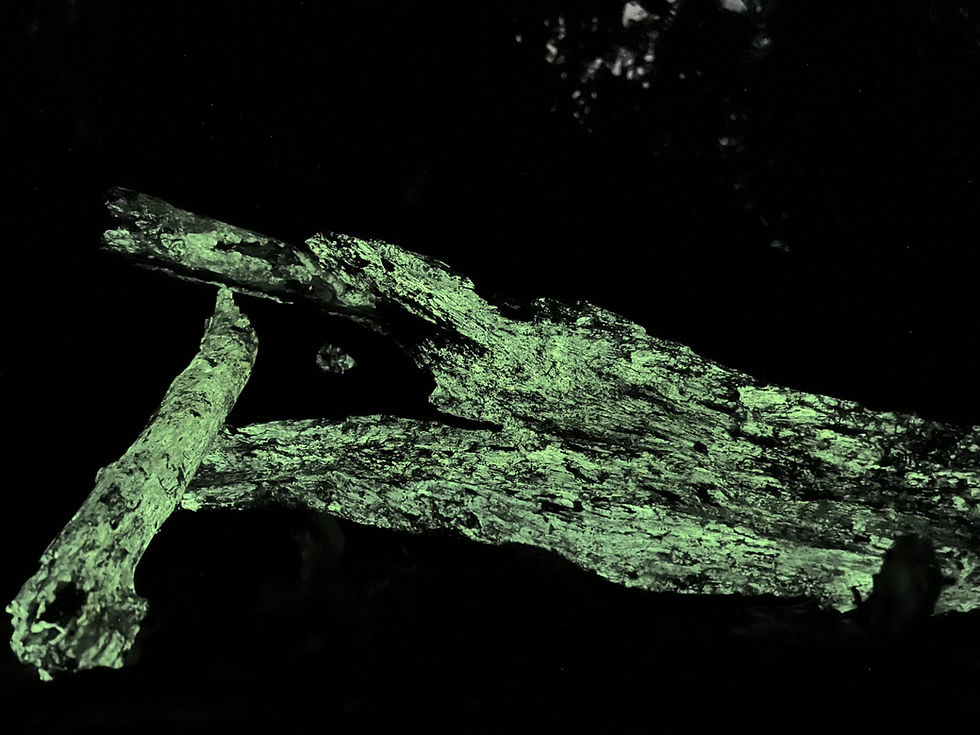
At first you see nothing. Just dark earth, damp from the rain. And then, slowly, your eyes adjust, and you notice it. A faint, ghostly blue green light, glowing quietly from the forest floor. Not blinking. Not sparkling like a firefly. Just glowing, steady and strange, like something out of a dream you didn't know you were having.
That's bioluminescence. And for a few short months every year, deep in the forests of Goa, it's real.
Most people who visit Goa never see it. Most people who live in Goa have never seen it either. It only appears under very specific conditions, in very specific places, for a very short window of time. If you've never heard of it before this moment, you're not alone. That's part of what makes it so extraordinary.
Keep reading. This forest has a story worth knowing before you ever set foot in it.
What Exactly Is Bioluminescence?
Bioluminescence is light produced by a living organism, through a chemical reaction happening inside its own body. No electricity, no fire, no external light source. Just chemistry, quietly at work in the dark. Inside the organism, a molecule called luciferin reacts with oxygen, catalysed by an enzyme called luciferase. That reaction releases energy in the form of light instead of heat, which is why the glow feels cool and otherworldly rather than warm like a flame.
In Goa's forests, the light usually comes from bioluminescent fungi, tiny organisms living on decaying wood and leaf litter on the forest floor. After heavy monsoon rain, when the ground is soaked and the air is thick with moisture, these fungi become active, and some species begin to glow faintly through the night. Scientists still debate exactly why certain fungi evolved this trait. Some believe the glow attracts insects that help disperse spores. Others think it may simply be a byproduct of the fungi's metabolic processes. Either way, the effect is the same. Places that look completely ordinary by day transform into something quietly magical after dark.
It isn't a trick of the light or a filter on someone's camera. It's a living organism, doing something it has done for millions of years, largely unnoticed by the world above it.
Why So Few People Ever Get To See It
Bioluminescence isn't something you can plan for on any random evening in Goa. It depends on a very particular alignment of conditions, and that's exactly why it stays rare. It needs consistent monsoon rain to keep the forest floor saturated. It needs real darkness, far from streetlights and headlights, because even a small amount of ambient light can wash out a glow this delicate. It needs an undisturbed, healthy forest ecosystem, since these fungi only thrive where the leaf litter, deadwood, and soil have been left largely untouched.

And it needs the right season. In Goa, that window sits roughly between July and September, when the monsoon is at its most active. Outside those months, the forest floor dries out and the glow simply isn't there. Add to that the fact that these conditions only exist in a small number of forest pockets across the state, known mostly to naturalists who've spent years tracking them, and you start to understand why this isn't a common sight.
It isn't manufactured scarcity. It's just how nature works. Bioluminescence in Goa is a genuinely seasonal, genuinely rare phenomenon, and most people who visit the state, even repeat travellers, never get the chance to witness it.
Why This Isn't A Trail You Should Attempt Alone
It's tempting, once you know a glowing forest exists, to want to go find it yourself. We'd gently ask you not to. These forests are dense, unmarked, and disorienting after dark, even for people who know Goa well. Paths that look obvious in daylight disappear completely once the sun goes down. The terrain can be uneven, slippery from monsoon rain, and threaded with streams that are easy to misjudge in low light.
There's also wildlife to consider. Goa's forests are home to a range of nocturnal creatures, most of which want nothing to do with you, but all of which deserve to be approached with knowledge and respect rather than guesswork.
And then there's the forest itself. The very ecosystem that makes bioluminescence possible is fragile. Uninformed footfall, torchlight in the wrong places, or trampled leaf litter can disturb the exact conditions that allow the fungi to glow in the first place.
This isn't about fear. It's about respect, for the terrain and for the ecosystem. A trail like this rewards local expertise, not improvisation. Which is exactly why we built this experience the way we have.
How Soul Travelling Is Different
There's a difference between being shown something and being helped to understand it.
Anyone can walk you to a spot in the forest and say "look, it's glowing." We wanted to build something more meaningful than that. Our Bioluminescence Forest Experience isn't just a walk to a glowing patch of ground and back. It's an evening built around interpretation, where every stop on the trail becomes a small doorway into how this ecosystem actually works.

Along the way, our naturalists weave together the science of what's glowing and why, the ecology of the forest around you, and the local folklore that's grown up around these glowing woods for generations. You'll hear how Goan communities historically explained this phenomenon long before anyone understood the chemistry behind it, and how that folklore still shapes the way locals talk about these forests today.
The goal isn't just a great photo, though you'll likely get one. The goal is that you leave the forest understanding something you didn't before you arrived. Guests consistently tell us that what stays with them isn't just the glow itself, but the stories and science that gave it meaning.
Third Year Running
This is now our third monsoon season running the Bioluminescence Forest Experience, and every year has taught us something.
We've refined our routes based on where the ecosystem is healthiest and most stable. We've adjusted our timing to match rainfall patterns more precisely. We've improved everything from group logistics to trail safety to how we brief guests before entering the forest.
Thousands of guests have joined us on this trail since we began, and that experience shows in how smoothly each evening runs, from pickup to the final drop back to your stay. We don't say this to boast. We say it because trust matters when you're heading into a forest after dark, and we'd rather you know exactly how much groundwork sits behind an evening that might look, on the surface, like a simple walk in the woods.
Expert Naturalists, Not Just Guides
There's an important distinction between a guide and a naturalist, and it's one we take seriously.
A guide can lead you along a path and point out where to walk. A naturalist understands why the forest behaves the way it does. They can read the signs of a healthy ecosystem, recognise the calls of nocturnal wildlife, explain the relationship between the season's rainfall and the fungi's activity, and adapt the evening's storytelling to whatever the forest happens to be doing that particular night.
Our naturalists bring genuine ecological training to every trail. They understand conservation, forest behaviour, and the quiet complexity of a night ecosystem, from the insects and amphibians that come alive after dark to the deeper biodiversity that most visitors never think to notice.
This matters because a forest at night isn't a static backdrop. It's an active, living system, and the difference between a good evening and an extraordinary one often comes down to who's walking beside you.
Responsible Tourism
Of everything we do, this is the part we care about most.
We follow Leave No Trace principles on every trail. Nothing is disturbed, nothing is removed, and nothing is left behind. Our naturalists brief every group on ethical wildlife viewing before entering the forest, which means keeping voices low, minimising torchlight, and observing without ever attempting to touch or provoke.
Group sizes are kept deliberately small, in part so that our impact on the forest floor stays minimal night after night. We don't publicly share the exact locations of these bioluminescent patches, and we ask our guests not to either, because the moment a location becomes widely known, foot traffic tends to follow, and that foot traffic is precisely what damages the delicate conditions that make the glow possible in the first place.
A portion of the value we create through this experience goes back into supporting the conservation work and local knowledge that keeps these forests healthy. We think of every guest as a temporary steward of this place for the evening, not just a visitor passing through it.
This isn't a checklist we follow to look responsible. It's the only way an experience like this can exist for more than one season.
Small Groups, Minimal Impact
We intentionally cap the number of guests on each departure, and we don't apologise for that.
Smaller groups mean a quieter forest, which matters enormously here. Bioluminescence is subtle, and it takes patience, low light, and stillness to really see it. A large, noisy group simply can't have the same experience as a small, attentive one.
Smaller groups also mean less physical disturbance to the trail and the forest floor, better opportunities for our naturalists to actually interact with each guest rather than speaking to a crowd, and a meaningfully safer experience when moving through uneven terrain in the dark. This isn't about exclusivity for its own sake. It's about protecting both the quality of the evening and the health of the forest that makes it possible.
A Complete Evening, Not Just A Walk
We designed this experience to feel complete from the moment you're picked up to the moment you're dropped back.
Transport Included
You won't need to navigate unfamiliar roads in the dark, search for parking near a forest trailhead, or worry about finding your way back afterwards. Our team handles pickup and drop off, so the only thing you need to focus on is the evening itself.
Dinner Included
After the trail, there's dinner, a chance to sit down, relax, and talk through everything you just experienced with the people you shared it with. No searching for a restaurant that's still open late in monsoon season, no rushing to find food after a long walk. Just a proper close to the evening, shared over a meal.

Together, these details are what turn a forest walk into a complete, considered evening out, rather than an adventure you have to plan around.
What You'll Experience
Every night in the forest is a little different, which is part of what makes this experience so hard to fully describe in advance. You might come across bioluminescent fungi glowing quietly along the trail, or fireflies flickering through the undergrowth if the season allows. You'll likely hear frogs calling from somewhere near a stream, and the layered hum of night insects that most people never stop to notice. The sound of moving water is almost always somewhere nearby.
Our naturalists will help you tune into the rainforest ambience around you, from distant wildlife calls to the particular stillness that settles over a forest after dark. On clear nights, there may even be a chance for quiet stargazing before the walk ends.
None of this is scripted or guaranteed in the same way each time, because it's a living forest responding to its own rhythms, not a performance. That unpredictability is exactly what makes it feel real.
Conservation & Ethics
The ecosystem that makes this experience possible is more fragile than it might appear.
Bioluminescent fungi depend on undisturbed leaf litter, stable moisture levels, and minimal human interference to keep glowing season after season. That's the core reason we don't publicly disclose exact trail locations, and why we ask every guest to respect that same discretion after their visit.
We see this as a shared responsibility. Our naturalists carry the ecological knowledge, but every guest who walks this trail becomes part of protecting it, simply by moving quietly, staying on the path, and leaving the forest exactly as they found it. We'd always rather protect a place than popularise it, even if that means fewer people ever get to see it.
Why Seats Are Limited
We limit the number of seats on every departure for reasons that go beyond exclusivity.
Conservation comes first. Smaller groups genuinely reduce the impact on a fragile forest floor. Experience quality comes next, since the magic of this trail depends on stillness and attentiveness that simply isn't possible in a large crowd. Our small group philosophy shapes everything about how we've built this experience, from pacing to storytelling. And safety plays a real role too, since a smaller group is simply easier to guide carefully through dense, dark terrain.
This isn't artificial scarcity designed to create urgency. It's a genuine operational limit, born out of what this forest and this experience actually need to stay intact.
Frequently Asked Questions
When can I see bioluminescence in Goa?
The window is short, typically from July through September, depending on monsoon rainfall each year. Outside this period, the conditions needed for the glow simply aren't present.
Is the trail difficult?
The terrain is uneven and can be slippery after rain, but our naturalists guide the pace to suit the group. Reasonable fitness and sturdy footwear are all that's needed.
Is it safe to walk in the forest at night?
Yes, when guided by trained naturalists who know the terrain, the wildlife, and the trail conditions well. This is exactly why we don't recommend attempting it independently.
Will I definitely see the glow?
Bioluminescence is a natural phenomenon, not a performance, so no sighting can ever be guaranteed. What we can promise is an evening led by expert naturalists in one of Goa's most ecologically rich forest settings, whatever the forest chooses to show that night.
What should I bring?
Comfortable closed shoes, light rain protection during monsoon, and a sense of curiosity. Torches and safety equipment are provided by our team.
Nature Doesn't Perform on Demand
There's something worth sitting with here.
This glow will not wait for you. It doesn't appear on request, and it doesn't stay long. For a few months each year, deep in a quiet Goan forest, something rare and genuinely extraordinary happens almost entirely out of sight, known to very few, seen by even fewer.
Most people will go their whole lives without ever standing in a forest that glows.
If you're in Goa between July and September, you have a narrow, genuine chance to be one of the few who do. Not through a shortcut, not through luck, but through an evening built carefully, season after season, to protect the very thing it lets you witness.
Join the waitlist, or book your spot for this monsoon season with Soul Travelling, and see for yourself why so few people ever get to.