
Why Vietnam and Thailand Could Never Replace Goa’s Charm

In recent years, the travel debate has shifted. With rising costs and logistical hurdles in Goa, many travelers are looking toward the affordable shores of Da Nang or the neon-lit streets of Phuket. While Thailand and Vietnam offer incredible value and infrastructure, there is a soulful, irreplaceable essence to Goa that a passport stamp can’t quite replicate.
Here is why Vietnam and Thailand, as beautiful as they are could never truly replace the specific "charm" of Goa.
1. The Soul of "Susegad"
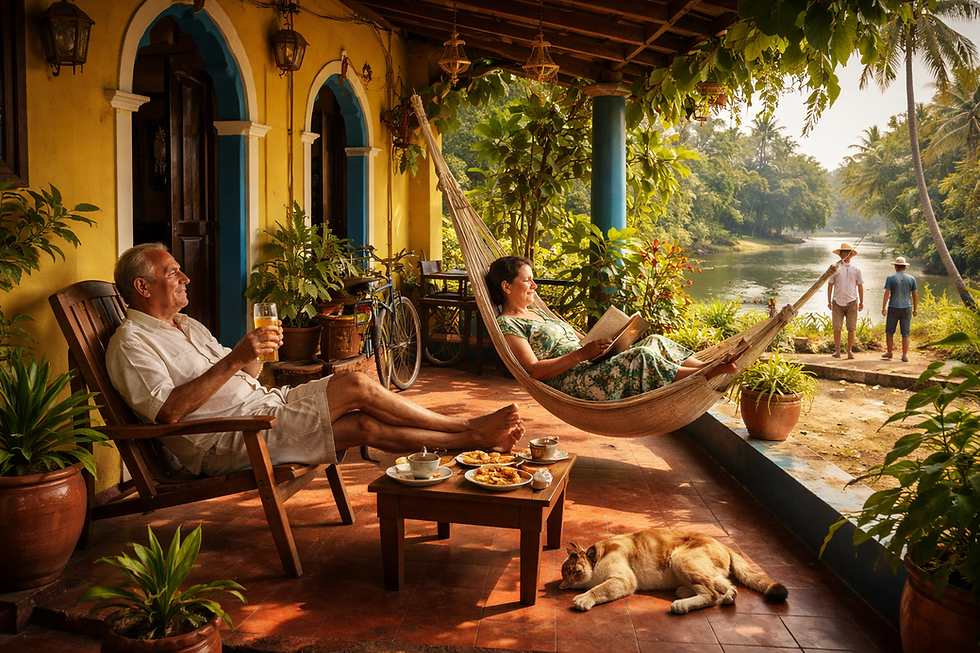
In Thailand, the vibe is often high-octane hospitality; in Vietnam, it’s a bustling, industrious energy. But Goa offers Susegad, a concept derived from the Portuguese word sossegado (quiet). It isn’t just relaxation; it’s a cultural DNA that encourages you to slow down, live in the moment, and let time become a mere suggestion. You don’t "do" Goa; you be in Goa. That specific laid-back, unhurried rhythm is hard to find in the more structured tourism hubs of Southeast Asia.
2. A Cultural Intersection: East Meets West
While Thailand and Vietnam have rich histories, Goa’s history is a unique 450-year-old Indo-Portuguese fusion. You can visit a 16th-century Baroque church in the morning and a Hindu temple in the afternoon, followed by a walk through the colorful Latin Quarter of Fontainhas. This Mediterranean-meets-Konkan aesthetic—white-washed chapels, azulejos tiles, and red-tiled villas, creates a visual and cultural landscape that is entirely singular.
3. The Culinary "Xacuti" Factor

Southeast Asian food is world-class, but it doesn’t have the specific nostalgic pull of Goan cuisine for the Indian palate. The tang of Kokum, the spice of Vindaloo, and the multi-layered decadence of Bebinca are flavors of "home" upgraded. There’s a certain magic in sitting at a beach shack with a chilled beer and a plate of rava-fried prawns that a bowl of Pho or Pad Thai, however delicious, cannot replicate.
4. The Global "Hippie" Heritage
Goa has been a sanctuary for spiritual seekers and rebels since the 1960s. This has left behind a legacy of a "global community." In places like Arambol or Anjuna, you aren't just a tourist; you’re part of a decades-old tradition of drum circles, flea markets, and trance parties. While Thailand has its Full Moon parties, Goa’s party scene feels more rooted in a subculture rather than just commercial tourism.
5. Ease of "Belonging"

For many, the charm of Goa lies in its accessibility, not just geographically, but emotionally. There is no language barrier, no currency exchange stress (for domestic travelers), and a sense of "belonging" that international destinations lack. You can rent a scooter, explore the lush hinterlands, and strike up a conversation with a local tavern owner in English or Hindi. It’s the "comfort food" of travel destinations.
6. The Village Behind the Beach
In Thailand and Vietnam, tourism often radiates outward from landmarks. In Goa, life radiates inward from villages. Beaches are just the edges. The heart of Goa beats in its villages, through fields, chapels, temples, bakeries, ferries, and evening walks. This is why many who fall deeply in love with Goa eventually move away from the coast and into the hinterlands.
They aren’t escaping crowds. They are moving closer to meaning.
7. Goa Doesn’t Try to Compete, and That’s Its Power
Vietnam and Thailand are rising stars in global tourism. They are expanding, refining, and accelerating. Goa, on the other hand, has reached a point of quiet resistance.
And that self-awareness, messy, imperfect, and often frustrating, is exactly what keeps Goa alive.
Final Thought: Why Goa Endures
Vietnam and Thailand will continue to rise in popularity. They are dynamic, efficient, visually striking, and rewarding in ways that modern travelers value. They offer discovery, contrast, and the thrill of the unfamiliar, and they deserve their place on every traveler’s map.
But Goa occupies a different space altogether.
Goa is not about novelty. It is about continuity.

It is a place where memory matters, where people return not to see something new, but to feel something familiar. Where the café owner remembers your name, the beach feels unchanged even as years pass, and certain roads instinctively slow you down, no matter how busy life has become elsewhere.
Goa doesn’t promise perfection. It offers presence.
Its charm lies in its contradictions: lively yet restful, deeply spiritual yet effortlessly indulgent, rooted in tradition yet open to the world. It allows you to be both a visitor and a participant, both an observer and someone who belongs, even if only for a few days.
While international destinations excite the senses, Goa speaks to something quieter. It meets you where you are. It grows with you. Each visit feels different, not because Goa has changed, but because you have.
That is why Goa resists replacement. You can travel far, cross borders, collect stamps, but certain places don’t compete. They endure.
Goa is one of them.
It doesn’t ask to be chosen.It simply waits.
And somehow, you always find your way back.